
Event Recap: Great Minds 2026 Exploring Hope, Grief, and Women’s Brilliance
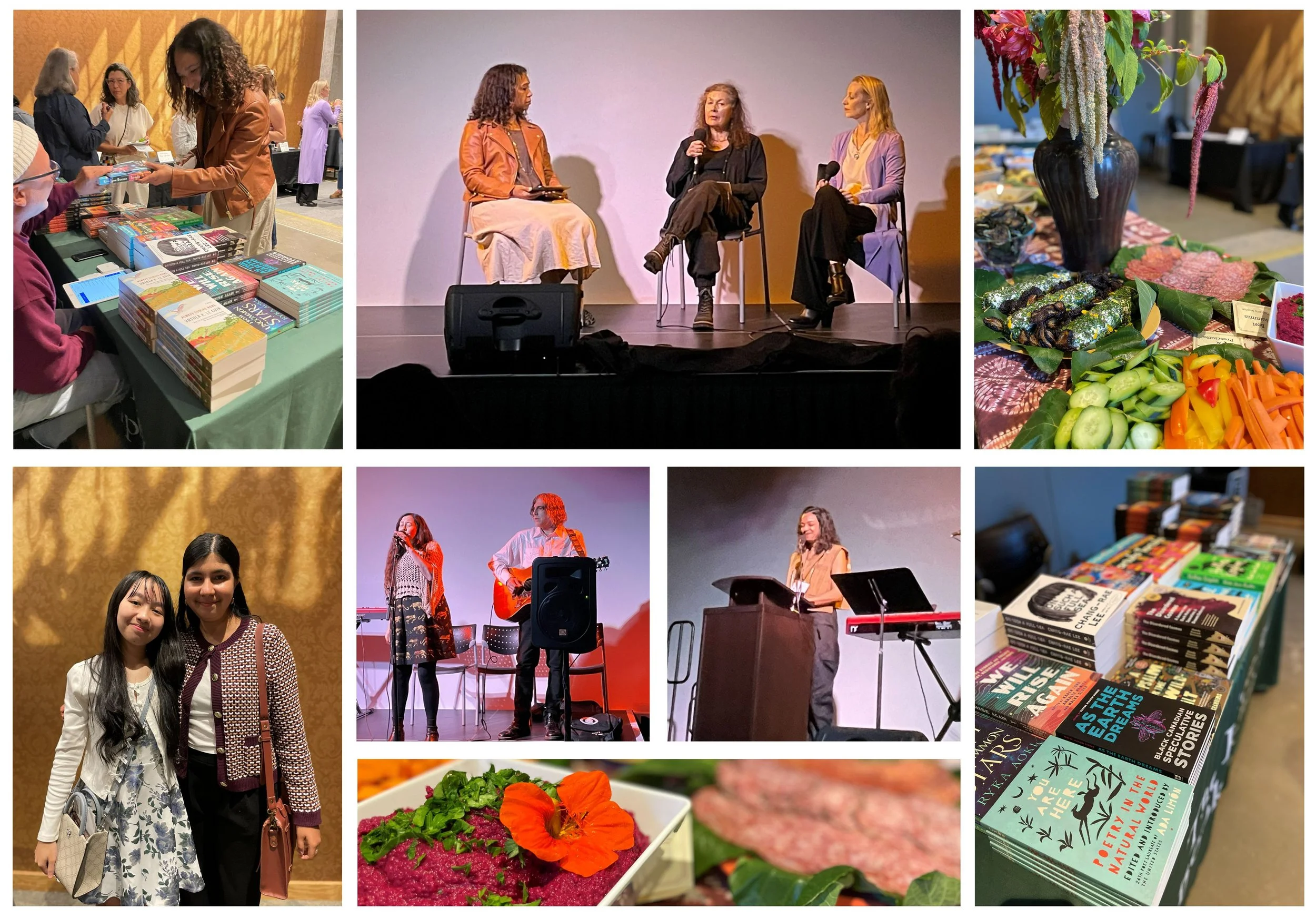
On Thursday, September 17, readers and writers gathered at Hugo House for Great Minds, an evening with Hedgebrook built around optimism, speculative futures, and the worlds we dream into being. The room vibrated with the energy of people who came to think seriously about hope.
Hedgebrook board member Vanessa Priya Daniel opened the evening. She talked about the importance of stories and direct communication as an act of love. Vanessa carried the analogy into a description of Hedgebrook itself: a global community of women writers… a place where brilliance is given room to unfurl. She offered a line from Gloria Steinem, may she rest in power, to carry through the evening: "Hope is a form of planning."
Seattle's 2026/2027 Youth Poet Laureate, Sirjana Kaur, read next. Her poem, drawn from her very recent experience of leaving home for college, explored the bittersweet finality of “last experiences” in the days before departure. "On the highway, I count the streetlights for everything that is ending."
Musical Performances
For the fourth year, we were joined by the Bushwich Book Club. Executive Director Geoff Larson introduced three singer-songwriters who were each given a book by one of our panelists as inspiration. Their job was to translate the private act of reading into original music.
Singer and pianist Emily Persha shared a piece written from the perspective of a truffle hound devoted to her human, set to Kira Jane Buxton's novel Tartufo. Matching with the novel, it was written in the key of D-Minor and with an over-the-top dramatic flourish. Funny and slightly irreverent, it captured the spirit of the book perfectly, including Kira Jane Buxton’s foul-mouthed humor: “I’ll deliver to you nature’s greatest wonder, ‘cause I’m a mother fucking truffle hunter.” The audience was uproarious with laughter.
Brittany Daniels, also a singer and pianist, wrote for Kathleen Alcalá, giving voice to life’s meaning, experiences, and interactions, especially for those who might not yet have the words to describe them. She sang about the tension between building a better future for our children and staying present: "You can't create the future if you don't understand what's going on right now." This piece reverberated with everyone in the room.
Adrienne Pierce, a singer accompanied on guitar, pulled inspiration from an excerpt from one of Rashida J. Smith’s novels. One of Rashida’s characters is a magical person who has to hide her true abilities, and Adrienne sang about the courage it takes to bring one's whole self into a room. She asked the question so many of us carry: "Are you a friend or are you a stranger?"
Rashida shouted her approval from the audience, noting that it would be very hard to do her job as panel moderator following a performance that made her cry. All three panelists, and the entire audience, were wow’d by the texts translated into song.
Authors in Conversation
The heart of the evening arrived with Great Minds in Conversation, moderated by author and Clarion West Program Director Rashida J. Smith. Together with Kathleen Alcalá and Kira Jane Buxton, the three discussed where hope can live for a writer working within a world in crisis.
"You have to have hope to be a writer," Kathleen said. "Just showing kindness and compassion to other people can change the world.”
"I don't think it's naive to be hopeful,” said Kira. “I think it's an absolute necessity. Hope is a life raft. We must look to the light… We must be the light."
Both writers nodded to Hedgebrook itself as a source of that hope. Kathleen was one of our very first residents, before the residency program was officially established. She arrived at Hedgebrook 8.5 months pregnant, carrying an early computer (this was the 1990s) borrowed from her husband’s colleague. Her son was, as far as she knows, the first man at Hedgebrook.
Kira spoke about the impact of her time at Hedgebrook as well, where she was first able to see herself as a writer. “It’s very difficult to explain the magic of Hedgebrook,” said Kira. “To be nurtured as a writer and have the time you need where there’s no other expectation of you… it’s indescribable. It allows you to sink down deep with the work. Novel writing – and I hate to say this because I’m such an animal lover – is a lot like wrestling an octopus into a jar.”
Rashida described the impact of being seen and named as a writer, either by someone you admire or through a process like getting a residency at Hedgebrook. "It speaks to you on the soul level. We need people to tell us we belong in a space, and that our voice has a place. That's what Hedgebrook does for women writers."
Audience Q&A
We ended with an audience Q&A, kicked off by Hedgebrook cofounder Sheryl Feldman. She asked the panelists if they think women write differently about the future today than men would. “Our stories are so important because of our hard-fought battles,” said Kira. “I think we bring more gentleness and stories about growth and mutual empowerment and stand up against oppression.”
Women writers have been at the forefront of imagining (and reimaging) the future since the dawn of storytelling, Kira said. Some of our most popular pieces of speculative fiction were written by women. Take Frankenstein, for example, a book first published in 1818 anonymously by a 20-year old woman writer.
Kathleen guessed that one of the reasons women are leading this genre is because women have faced such an uphill battle for equality, a fight that is still very real today. “We mythologize some of these situations because we can’t deal with the reality of it,” said Kathleen. “It gives us a way to externally process these horrors that happen to us.”
Another attendee asked the panelists what they’re excited about when they look to the future. Rashida gave a heartfelt example. “I have an 11 year old. She’s amazing. And I get to see the world through her eyes. I want to help her actualize to the fullest of her potential.”
The conversation closed with a question about grief, and how it moves alongside hope in a writer's work. "Grief is an essential step before you can get to optimism and move on to what's next," Rashida said. Kathleen described her own process of writing through grief. “I’ve cried through many of the books that I’ve written. You just cry through it and then you write and then you cry and then you write. The joy is often through the sadness.”
For the closing benediction, our event host Vanessa took to the stage to tie together the themes of the evening. “To the hope of planting seeds and persevering. The hope of being looked in the eye and being named as a writer and bringing that magic to a table of other women writers.” She encouraged attendees to keep imagining better worlds and to lean into hope as a disciple rather than a passing mood. This, she said, is how we change the world.
Reading List & Thank You
The authors also put together a Recommended Reading List for those who want to continue the conversation. A huge thanks to our partners at Clarion West, the celebrated speculative fiction organization, as well as Seattle Arts and Lectures, Bushwick Book Club, and Hugo House.